
So, you just received a sample from your Chinese supplier.
The packaging is flawless. The quality is perfect. It is exactly the product you have been dreaming of.
In your mind, you are already picturing the sales exploding and the 5-star reviews rolling in.
Stop right there.
As a veteran in the China quality control industry who has spent years on factory floors, I need to pour a bucket of cold water on your excitement:
What you are holding is likely a “Golden Sample.”
The Harsh Reality
This sample was likely hand-crafted by the factory’s most experienced master. He spent hours using the finest materials just to get you to sign the contract.
But once you sign that $50,000 deal? Your mass production will likely be assembled by temporary workers who joined two days ago, rushing to meet a deadline.
The result? You receive a container full of defects and headaches.
Why Does Quality Drop After the Sample?
Factories don’t necessarily want to scam you. But they are desperate to squeeze a little more profit out of thin margins. (Note: This is why I always advise clients: Don’t bargain too hard. If you push the price below cost, you trigger these hidden traps.)
Here are their common tactics:
1. The “Bait and Switch” (Material Substitution)
- The Trick: The sample uses 304 Stainless Steel (which never rusts). The mass production uses a cheaper alloy or 201 Steel.
- The Consequence: They look identical now. But in three months, your customers’ complaints about rust will flood your inbox.
2. Process Skipping
- The Trick: To catch the shipping date or save electricity bill, they skip essential steps like fine polishing or heat treatment.
In the sourcing world, we have a saying: “The sample is gold, but the cargo is trash.”
If you don’t have a professional product inspection service in place, you are not importing products; you are importing trouble.
The Solution: How to Break the Trap
As a qualified businessman, you cannot rely on luck. Every country has good factories and bad factories.
We must follow the golden rule: “Trust, but Verify.” You need to control your own quality loop.
Step 1: The Sealed Sample (Your Quality Mirror)
Never rely on memory. You must keep multiple samples that are signed and dated by both the factory manager and your agent in China.
- Copy A: Stays at the factory as the production standard.
- Copy B: Stays with a third party (like Leo Li) as the inspection standard.
Without aSealed Sample, inspection is just an argument. With it, inspection is like looking in a mirror—no disputes allowed.
Step 2: DPI (During Production Inspection)
Many bosses wait until the goods are 100% finished and packed to send an inspector.
That is too late.
If you find wrong materials or defects then, the factory will try to hide them to sell their stock. Or worse, you miss your shipping date because they have to rework everything.
The Rule: You must inspect when production is 30% complete. At this stage, if there is a problem, the factory still has time to fix it without delaying your shipment.
Leo Li’s Value: Your “Mobile Safe” in China
Why can my clients enjoy their weekends peacefully overseas?
Because I don’t sit in an air-conditioned office reading reports. I stand on the dusty factory floors staring at the assembly line.
Here is exactly what I do for you:
- Sample Custody: You ship your Sealed Sample to me. I lock it in my safe.
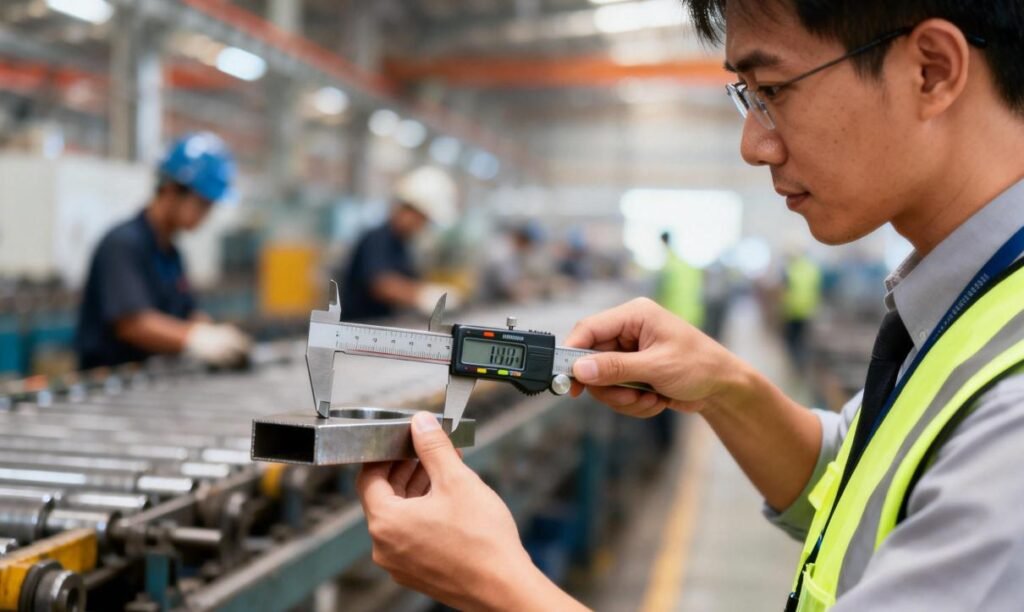
- Live Comparison: On inspection day, I take your sample to the workshop and compare it side-by-side with the mass production units.
- Zero Tolerance: If the steel thickness is off by even 0.2mm, I stop the line immediately. I am not afraid to offend the factory because I work for you, and I am responsible for your profit.
In this sourcing race full of traps, you need an “Old Friend” who guards your bottom line.
🚀 Action: Don’t Wait Until It’s Too Late
Is your mass production about to start? Are you feeling uneasy about the factory’s promises?
Send me your product specs and requirements now.
I can provide a preliminary factory audit or design a detailed Quality Control Plan for you.
- WhatsApp: +86 15759861323
- Email: mychinamate@Gmail.com
The “Miniature Model” Scam: A China Sourcing Nightmare (2026)
FOB vs DDP: How to Avoid the “Cheap Shipping” Scam
How to Verify Product Samples Without Flying to China: The Lowest Cost Strategy (2026)
Why Sourcing from China is Unbeatable: The Brutal Truth
Factory vs. Trading Company: How to Spot a Liar in 5 Minutes (The Video Call Ambush)