
If you run an Amazon or Shopify store, during your product research, you will definitely notice this: you see a product in a competitor’s store priced at only $14.99, sometimes even with free shipping. When you image-search or go to B2B platforms like Alibaba to find the sourcing price, you realize that the product cost, plus shipping and platform advertising fees, almost equals their selling price.
How are they making money? Forget making money, it seems like they might even be losing money. They are absolutely not failing to make a profit, nor are they selling at a loss just to build a reputation. They simply know how to squeeze costs to the absolute minimum through various channels.
As a sourcing agent with many years of experience, I can explain to you how they compress their costs through these different channels.
Usually, novice sellers start looking for suppliers on Alibaba. Most of the sellers there are actually trading companies and shell companies cooperating with factories. They rely on the cooperation between factories and platforms, paying high advertising fees to grab rankings and find customers. Of course, these fees will ultimately be paid by you in the form of higher quotes.
Top-tier sellers usually dive directly into Chinese supply chain cities. Generally, every city in China has a representative industrial belt with many factories in the same industry. They abandon the platforms and turn to visiting China or finding a sourcing agent in China to access first-hand source factories. I usually represent my clients to communicate directly with factories, negotiating in Chinese to guarantee the local Chinese price, which directly cuts off the 30% middleman markup for you.
Usually, if you source multiple products without a middle agent to reorganize the space, it is easy to overpay for shipping during ocean freight due to insufficient space utilization. If multiple products are shipped separately to the destination country, the freight cost will multiply.
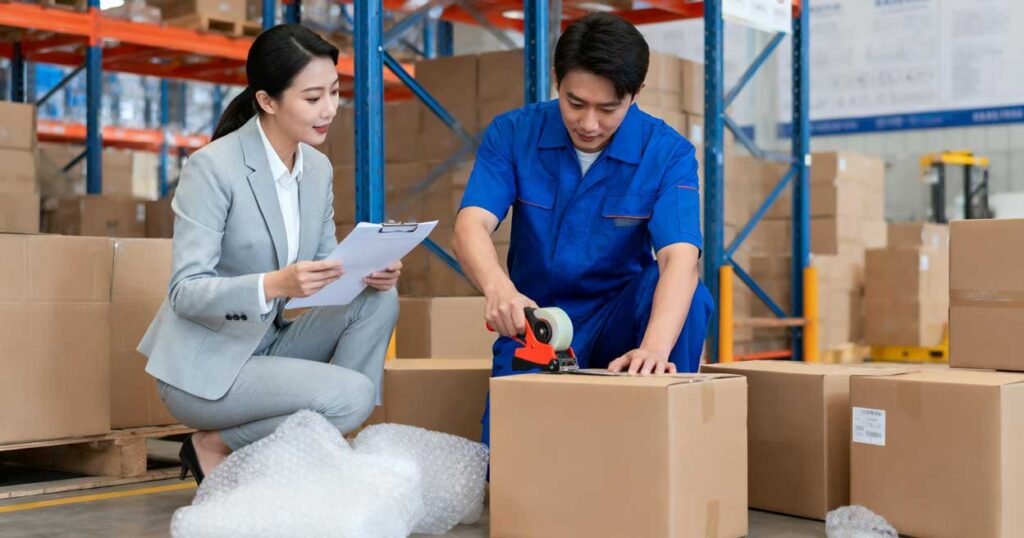
Therefore, before shipping, the cargo must be “slimmed down.” Removing overly heavy cardboard box packaging and replacing it with lightweight bubble wrap and other similar operations will help reduce large freight costs.
For example, for an all-metal product, we can ask the factory to replace the materials. Unimportant parts can be replaced with cheaper materials, keeping the original high-strength materials only in key areas. This not only reduces the product cost but also reduces the product’s weight.
Many suppliers will absolutely keep this a secret: if your order is large enough, Chinese policies provide tax rebate benefits to trading companies. This amount depends on the product category and is a significant chunk of extra profit generated out of nowhere.
Seeing this, you should understand: those competitors who sell cheaply and still make money are not just lucky to have found some “magical factory.” It is because they have optimized every single step to the extreme: sourcing, price negotiation, packaging optimization, and logistics consolidation.
If you are thousands of miles away in Europe or America, it is very difficult to control all of this relying solely on a few emails and WhatsApp messages. You need an “insider” in China.
Stop having headaches over the high quotes and shipping fees on Alibaba. Send me your product links, and let me do a free cost diagnosis for you to see how much I can drive down your sourcing price!